








Death of Communism's Last Dictator
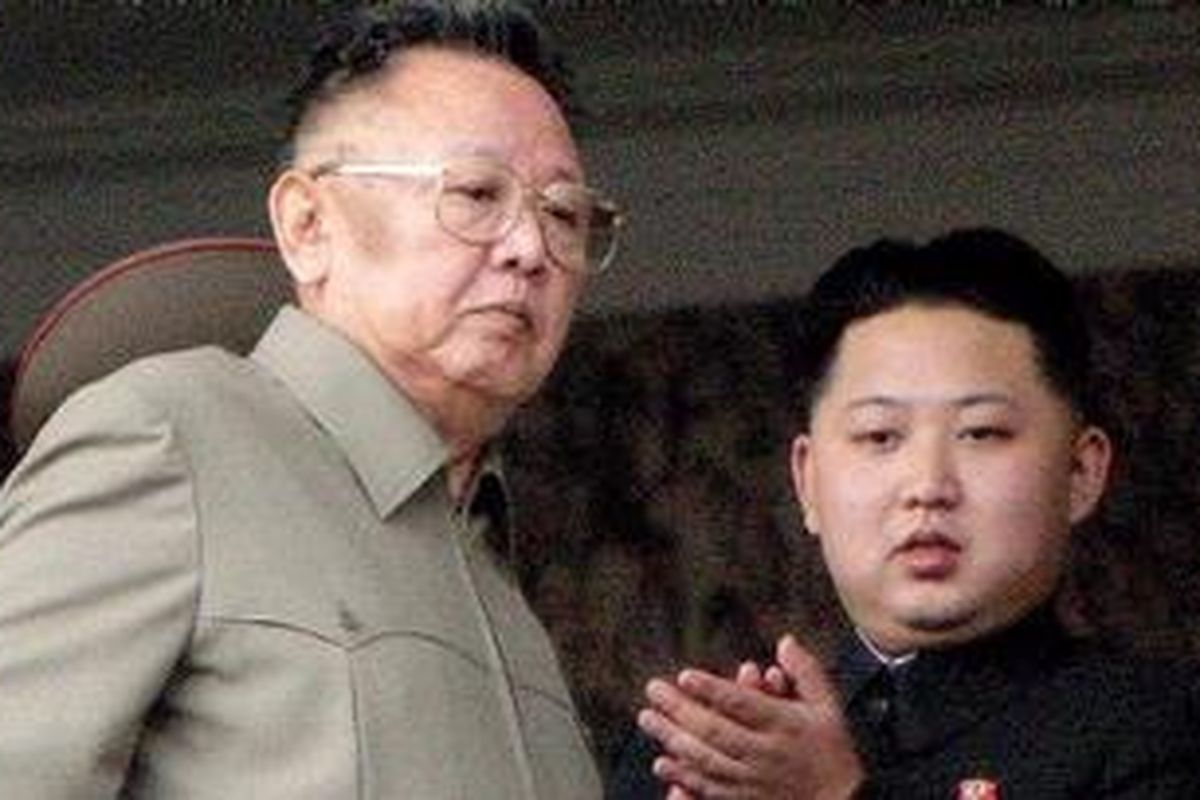


KOMPAS.com - Kim Jong Il, North Korea's diminutive but ruthless dictator who has led the communist regime since 1994, has died. He was 69.
Kim's death was announced last night by state television from the North Korean capital, Pyongyang.
In a 'special broadcast,' North Korea's state media said Kim died on Saturday of a heart ailment on a train due to a 'great mental and physical strain' during a 'high intensity field inspection.'
Kim was believed to have suffered a stroke in 2008 but appeared relatively vigorous in photos and video from recent visits to China and Russia and in numerous trips around the country carefully documented by state media.
The South Korean military declared an emergency alert minutes after news of his death went public. Traffic in the capital was moving as usual on Monday, but the eyes of people in the streets were flooded with tears as they learned the news of Kim's death.
A foreigner contacted at Pyongyang's Koryo Hotel said hotel staff were in tears. Kim's funeral is planned for December 28 in Pyongyang, with a mourning period to last until December 29.
The White House said on Sunday that President Obama was told of Kim's death. Obama's Press Secretary Jay Carney said in a statement: 'We are closely monitoring reports that Kim Jong Il is dead.
'The President has been notified, and we are in close touch with our allies in South Korea and Japan.'
The Obama administration may postpone decisions on re-engaging North Korea in nuclear talks and providing it with food aid, U.S. officials said Sunday.
The administration had been expected to decide on both issues this week, possibly as early as Monday, but the officials said Kim's death would likely delay the process.
The officials spoke on condition of anonymity due to the sensitivity of the situation. They said the U.S. was particularly concerned about any changes in the military postures of North and South Korea but were hopeful that calm would prevail.
North Korea is calling Kim Jong Il's son a 'great successor' to the country's guiding principle of self reliance, as the country rallies around heir-apparent Kim Jong Un as the next leader.
The North's official Korean Central News Agency says the country 'must faithfully revere respectable comrade Kim Jong Un.'
North Korea urged its 24million people to rally behind Kim Jong Un as it mourns the death of supreme leader Kim Jong Il.
In response to Kim's demise, the U.S. dollar jumped as uncertainty in North Korea increased the U.S. unit's safe-haven appeal.
Asian stock markets moved lower amid the news, which raises the possibility of increased instability on the divided Korean peninsula.
South Korea's Kospi index was down 3.9 percent at 1,767.89 and Japan's Nikkei 225 index fell 0.8 percent to 8,331.00.
Hong Kong's Hang Seng slipped 2 percent to 17,929.66 and the Shanghai Composite Index dropped 2 percent to 2,178.75.
The news of Kim's death came as North Korea prepared for a hereditary succession. Kim Jong Il inherited power after his father, revered North Korean founder Kim Il Sung, died in 1994.
In September 2010, Kim Jong Il introduced his third son, the twenty-something Kim Jong Un, as his successor, placing him in high-ranking posts.
Kim Jong Il had been groomed for 20 years to lead the communist nation founded by his guerrilla fighter-turned-politician father and built according to the principle of 'juche,' or self-reliance.
Even with a successor, there had been some fear among North Korean observers of a behind-the-scenes power struggle or nuclear instability upon the elder Kim's death.
Few firm facts are available when it comes to North Korea, one of the most isolated countries in the world, and little is clear about the origins of the man known as the 'Dear Leader.'
North Korean legend has it that Kim was born on Mount Paekdu, one of Korea's most cherished sites, in 1942, a birth heralded in the heavens by a pair of rainbows and a brilliant new star.
Soviet records, however, indicate he was born in Siberia, in 1941. Kim Il Sung, who for years fought for independence from Korea's colonial ruler, Japan, from a base in Russia, emerged as a communist leader after returning to Korea in 1945 after Japan was defeated in World War II.
With the peninsula divided between the Soviet-administered north and the U.S.-administered south, Kim rose to power as North Korea's first leader in 1948 while Syngman Rhee became South Korea's first president.
The North invaded the South in 1950, sparking a war that would last three years, kill millions of civilians and leave the peninsula divided by a Demilitarized Zone that today remains one of the world's most heavily fortified.
In the North, Kim Il Sung meshed Stalinist ideology with a cult of personality that encompassed him and his son.
Their portraits hang in every building in North Korea and on the lapels of every dutiful North Korean. Kim Jong Il, a graduate of Pyongyang's Kim Il Sung University, was 33 when his father anointed him his eventual successor.
Even before he took over as leader, there were signs the younger Kim would maintain - and perhaps exceed - his father's hard-line stance.
South Korea has accused Kim of masterminding a 1983 bombing that killed 17 South Korean officials visiting Burma, now known as Myanmar.
In 1987, the bombing of a Korean Air Flight killed all 115 people on board; a North Korean agent who confessed to planting the device said Kim ordered the downing of the plane himself.
Kim Jong Il took over after his father died in 1994, eventually taking the posts of chairman of the National Defense Commission, commander of the Korean People's Army and head of the ruling Worker's Party while his father remained as North Korea's 'eternal president.'
He faithfully carried out his father's policy of 'military first,' devoting much of the country's scarce resources to its troops - even as his people suffered from a prolonged famine - and built the world's fifth-largest military.
Kim also sought to build up the country's nuclear arms arsenal, which culminated in North Korea's first nuclear test explosion, an underground blast conducted in October 2006.
Another test came in 2009. Alarmed, regional leaders negotiated a disarmament-for-aid pact that the North signed in 2007 and began implementing later that year.
However, the process continues to be stalled, even as diplomats work to restart negotiations. North Korea, long hampered by sanctions and unable to feed its own people, is desperate for aid.
Flooding in the 1990s that destroyed the largely mountainous country's arable land left millions hungry. Following the famine, the number of North Koreans fleeing the country through China rose dramatically, with many telling tales of hunger, political persecution and rights abuses that officials in Pyongyang emphatically denied.
Kim often blamed the U.S. for his country's troubles and his regime routinely derides Washington-allied South Korea as a 'puppet' of the Western superpower.
U.S. President George W. Bush, taking office in 2002, denounced North Korea as a member of an 'axis of evil' that also included Iran and Iraq. He later described Kim as a 'tyrant' who starved his people so he could build nuclear weapons.
'Look, Kim Jong Il is a dangerous person. He's a man who starves his people. He's got huge concentration camps. And... there is concern about his capacity to deliver a nuclear weapon,' Bush said in 2005.
Kim was an enigmatic leader. But defectors from North Korea describe him as an eloquent and tireless orator, primarily to the military units that form the base of his support.
The world's best glimpse of the man was in 2000, when the liberal South Korean government's conciliatory 'sunshine' policy toward the North culminated in the first-ever summit between the two Koreas and followed with unprecedented inter-Korean cooperation.
A second summit was held in 2007 with South Korea's Roh Moo-hyun. But the thaw in relations drew to a halt in early 2008 when conservative President Lee Myung-bak took office in Seoul pledging to come down hard on communist North Korea.
Disputing accounts that Kim was 'peculiar,' former U.S. Secretary of State Madeleine Albright characterized Kim as intelligent and well-informed, saying the two had wide-ranging discussions during her visits to Pyongyang when Bill Clinton was U.S. president.
'I found him very much on top of his brief,' she said.
Kim cut a distinctive, if oft ridiculed, figure. Short and pudgy at 5-foot-3, he wore platform shoes and sported a permed bouffant.
His trademark attire of jumpsuits and sunglasses was mocked in such films as Team America: World Police, a 2004 film from South Park creators Trey Parker and Matt Stone populated by puppets.
Kim was said to have cultivated wide interests, including professional basketball, cars and foreign films. He reportedly produced several North Korean films as well, mostly historical epics with an ideological tinge.
A South Korean film director claimed Kim even kidnapped him and his movie star wife in the late 1970s, spiriting them back to North Korea to make movies for him for a decade before they managed to escape from their North Korean agents during a trip to Austria.
Kim rarely traveled abroad and then only by train because of an alleged fear of flying, once heading all the way by luxury rail car to Moscow, indulging in his taste for fine food along the way.
One account of Kim's lavish lifestyle came from Konstantin Pulikovsky, a former Russian presidential envoy who wrote the book 'The Orient Express' about Kim's train trip through Russia in July and August 2001.
KOMPAS.com berkomitmen memberikan fakta jernih, tepercaya, dan berimbang. Dukung keberlanjutan jurnalisme jernih dan nikmati kenyamanan baca tanpa iklan melalui Membership. Gabung KOMPAS.com Plus sekarang




